

Business Term Loan Requirements: What Lenders Look For
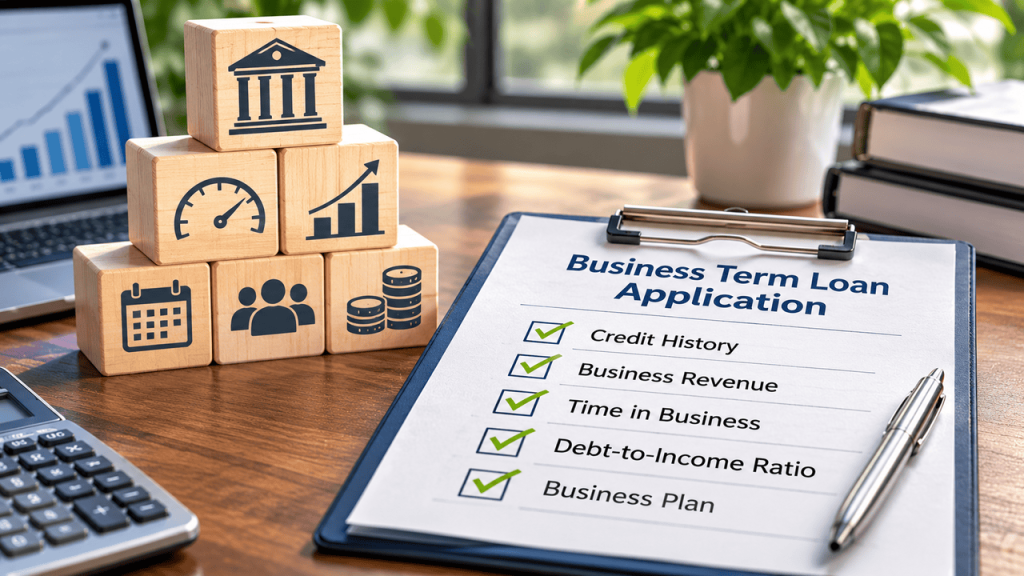
Most business owners approaching a term loan application feel the same thing: a low-grade anxiety that they’re missing something, that some undisclosed threshold will disqualify them before they even get a fair look. You might find yourself thinking, I need this to be simple, and I just want to know my options without getting talked into something. That feeling is completely understandable, but it is also preventable when you know what to expect. Preparation changes everything. The business term loan requirements lenders use to evaluate applications are not arbitrary; they follow a consistent logic centered on credit history, operational stability, and cash flow health. Understanding that logic in advance lets you walk into the process with a clear picture of where you stand. With a Smarter Credit Loan Coach by your side, you can prepare with confidence and find a clear path forward.
Understanding the Core Pillars of Business Term Loan Eligibility
A business term loan is a structured debt product that delivers a lump sum of capital upfront, which the borrower repays over a defined period with interest. The use cases are broad, including working capital, inventory purchases, fixed asset acquisition, and debt refinancing, and so is the borrower pool. According to the McKinsey Institute for Economic Mobility, small and medium-sized businesses with fewer than 500 employees make up 99% of all U.S. companies, employ over 60 million workers, and generate 35% of all business revenue. For enterprises at that scale, access to term debt is often the mechanism that separates a growth opportunity from a missed one. Capital fuels growth.
Government-backed programs, particularly those administered through the U.S. Small Business Administration and its certified lending partners, have expanded that access. Per the SBA Lender Guidelines, the federal guarantee on SBA-backed loans reduces institutional risk enough that lenders can extend more favorable rates and longer repayment terms to borrowers who might not clear the bar for standard commercial credit. That backstop matters especially now. Millions of baby boomer business owners are approaching retirement, and the wave of ownership transitions that follows will require financing structures capable of preserving the employment and economic stability those businesses represent, as the McKinsey Institute for Economic Mobility research makes clear. Understanding what lenders require is the first step toward securing that capital.
Credit and Operational History Requirements
How Lenders Evaluate Your Credit Profile
Credit evaluation for a business term loan covers more ground than a single score. Depending on the lender and product, underwriting may include the business, its owners, and required guarantors. The underlying question is consistent: does the applicant have a demonstrated track record of managing debt responsibly?
It is natural to ask whether exploring financing will affect your credit. Ask which stage involves a soft inquiry and whether a later application or lender underwriting may require an authorized hard inquiry. Do not assume that every financing request is credit-impact-free.
Where lenders differ is in how much weight they assign to imperfect histories. Traditional banks typically hold applicants to higher credit thresholds, while alternative and online lenders often accept a wider range of credit profiles in exchange for adjusted pricing or shorter terms. Because the specific score cutoffs vary by institution and loan product, and are not standardized across the market, the most useful preparation is a thorough review of your own credit profile, both personal and business, before you apply. Knowing where you stand lets you target the right lenders and address any reporting errors that might be dragging your profile down.
Operational History and Time-in-Business Rules
Time in business functions as a measure of stability, but requirements vary by lender and financing product. A specialized SBA program’s operating-history rule should not be presented as a universal minimum for a business term loan.
- Traditional banks and alternative lenders: Minimum time-in-business requirements vary by institution. Conceptually, the longer your operating history, the more data a lender has to evaluate repayment risk; newer businesses typically face higher scrutiny or narrower product options.
A longer operating history can provide more information about revenue, expenses, and repayment capacity. It does not establish that a business is profitable or guarantee approval; lenders still review current performance and the proposed payment burden.
Explore available business financing options with Smarter Credit. Ask what credit inquiry, if any, applies at each stage before proceeding.
Revenue, Cash Flow, and Debt Refinancing Rules
Lenders evaluating revenue and cash flow are asking one central question: can this business support the proposed debt alongside its existing obligations? Prepare current financial statements, and provide accounts receivable and payable agings or inventory reports when relevant to the lender’s review. The required records depend on the business and financing product.
Debt service coverage ratios and minimum annual revenue thresholds vary by lender and loan product, and no single published standard governs the entire market. What is consistent is the underlying logic: lenders want to see that your cash inflows reliably exceed your cash outflows by a margin sufficient to absorb the new payment obligation. Businesses that can demonstrate that margin clearly, with clean and current financials, move through underwriting faster and with fewer complications.
Refinancing existing commercial debt carries its own conditions, which vary by lender and program. Ask the provider to confirm eligible debt, any seasoning or payment-history requirements, permitted uses of proceeds, and the expected benefit of refinancing. A two-year debt age and twelve-month payment history should not be stated as universal business-refinancing rules.
The specific financial reports lenders typically request include:
- Timely and accurate financial statements, such as balance sheets and profit and loss statements that reflect current operating conditions, not year-old snapshots.
- Accounts receivable and accounts payable agings, which reveal how quickly the business collects from customers and pays its vendors.
- Inventory reports, particularly relevant for product-based businesses where inventory levels directly affect liquidity.
- Several months of business bank statements to verify that the cash flow patterns in your financial statements match actual account activity; the specific number of months varies by lender.
Equity injection and personal guarantees are separate underwriting questions. Requirements depend on the program, transaction, and ownership structure; for SBA financing, the agency states that individuals owning 20% or more of the applicant must provide an unlimited personal guarantee.
Required Documentation and Collateral Policies
Organizing Your Paperwork
Documentation requirements are where many applications slow down unnecessarily. For SBA 7(a) financing, obtain the current lender checklist, including SBA Form 1919 when applicable. Non-SBA term loans have their own document requirements. Completing the requested forms accurately and organizing supporting records before applying can help avoid preventable delays.
Beyond Form 1919, lenders will typically request updated financial statements, tax returns for the business and its principals, accounts receivable and payable agings, and identification documentation. The exact checklist for non-SBA commercial term loans varies by institution, but the preparation principle is universal: gather your documents before you start the application, not during it. Applicants who arrive at the process with organized, current financials signal to lenders that they run a tight operation, and that signal carries weight in underwriting.
Collateral and Personal Guarantees
Collateral requirements vary by lender and program. The following SBA example should not be treated as the rule for every business term loan:
- For 7(a) Small loans of $50,000 or less, the SBA does not require collateral.
- Above that amount, the applicable SBA loan type, loan size, and current program rules determine the collateral treatment, together with lender requirements. Ask the lender which requirements apply to the specific request.
- A personal guarantee is separate from whether particular assets secure the loan. SBA states that individuals owning 20% or more of the applicant must provide an unlimited personal guarantee; non-SBA requirements depend on the funding provider.
SBA guidance for specified programs says a loan should not be declined solely because collateral is inadequate. That does not mean collateral, guarantees, creditworthiness, or repayment capacity can be ignored, and it does not guarantee approval.
Frequently Asked Questions About Business Term Loans
How difficult is it to qualify for a $100,000 business loan?
Qualifying for a $100,000 business loan depends on the provider’s evaluation of revenue, cash flow, time in business, credit, existing obligations and intended use of funds. Ask which collateral and personal-guarantee requirements apply to the specific product. No single minimum operating history or credit score guarantees approval.
What is the payment on a $1,000,000 business loan?
The payment on a $1 million business loan depends on the rate, term, payment frequency, and amortization structure. For illustration, a fully amortizing loan at a fixed 7% annual nominal rate, repaid monthly over ten years with no fees, has a calculated payment of about $11,611 per month. This is a hypothetical calculation, not an available offer or an all-in APR disclosure.
What disqualifies you from getting an SBA loan?
An SBA application may fail to qualify because of program eligibility restrictions, repayment concerns, credit issues, or other facts the lender must review. Check the current rules, including ownership and citizenship requirements, rather than relying on an old checklist. Inadequate collateral alone is not the same as an otherwise eligible and creditworthy application, and no single factor guarantees approval.
What are the requirements to qualify for a term loan?
Lenders generally review repayment capacity, credit history, operating history, existing debt, and the intended use of funds. Prepare current financial records and ask for the exact provider’s requirements. Specialized SBA program rules are not universal; term-loan minimums, collateral, guarantees, and any equity injection depend on the program and transaction.
What are the disadvantages of a term loan?
A term loan creates a repayment obligation even when revenue falls. Payments may be fixed or may change under a variable-rate structure, and payment frequency depends on the product. Other drawbacks can include interest and fees, collateral or guarantee exposure, and prepayment restrictions where the agreement provides them. Review the actual payment schedule and total cost before signing.
Navigating these requirements is easier when the financing request is specific: amount, business purpose, timing, current financial performance, and existing obligations. A Smarter Credit Loan Coach can help you explore available options through its funding partners. Request a review or learn more about term loans. Approval and final terms depend on the funding provider.