

Business Line of Credit vs. Business Loan: How to Choose the Right Financing for Your Goals
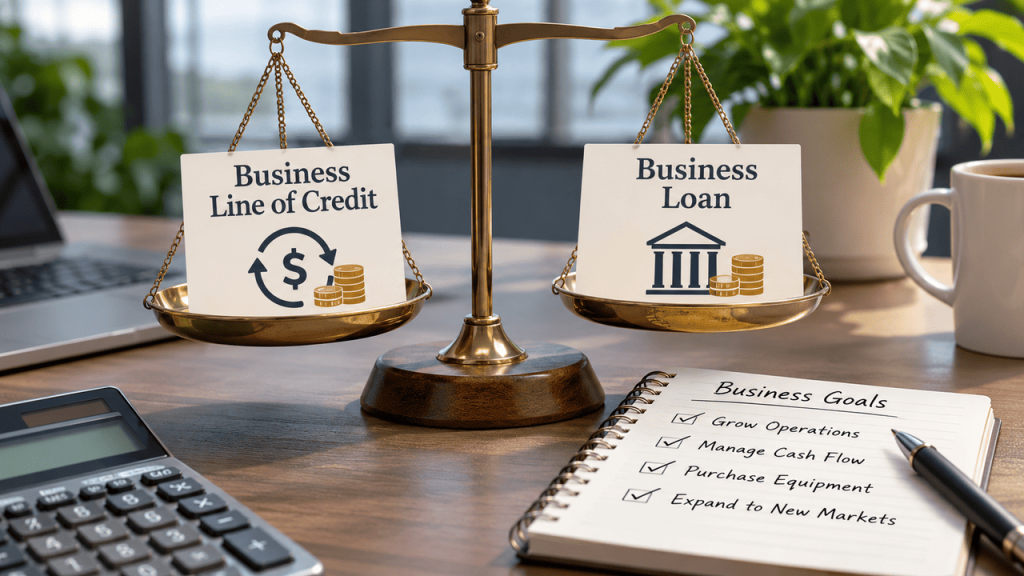
When comparing a business line of credit vs. a business loan, first define the loan being discussed. A credit line is itself a form of business financing; this article compares a revolving line with a lump-sum term loan. A line may suit recurring cash-flow gaps, while a term loan may suit a defined investment. Costs, payment schedules, and availability depend on the agreement.
Navigating business financing can feel complicated, including understanding what a credit review involves. Ask whether the initial request uses a soft inquiry and whether a later application or lender review may involve an authorized hard inquiry. Do not assume every step is credit-impact-free.
Understanding the Difference Between a Business Line of Credit and a Loan
A revolving business line of credit establishes an approved limit from which the business can draw, repay, and potentially borrow again while the facility is available and its conditions are met. A term loan generally provides a lump sum repaid over an agreed period. Paying down a line does not guarantee automatic renewal or unrestricted future draws.
A useful distinction is access versus a defined advance. A credit line offers access up to an approved limit, subject to its conditions, while a term loan funds a specified amount. Compare all charges: a line may include draw or maintenance fees, and a term loan’s cost depends on the outstanding balance, rate structure, and agreement.
Getting this distinction right matters more than most business owners initially realize. The wrong match costs money. Reaching for a high-interest revolving option to fund a multi-year equipment purchase, or locking capital into a fixed-term loan when you need flexible working capital, can generate real financial strain and erode the liquidity you need to operate day-to-day. A dedicated Loan Coach can help you map your actual operational needs to the right instrument, removing the guesswork from a decision that carries long-term consequences for your balance sheet.
How a Business Line of Credit Works: The Revolving Advantage
Under a revolving structure, borrowers may draw up to the available limit, repay outstanding amounts, and request further draws during the availability period, subject to the agreement. Scheduled repayments, fees, lender reviews, and restrictions still apply. This structure can help with temporary seasonal inventory or receivables-related cash gaps, but it does not guarantee permanent access to capital.
On many interest-based lines, interest is charged on the outstanding drawn balance rather than the full approved limit. If the limit is $150,000 and the balance is $40,000, the interest calculation may relate to that $40,000 balance. Other products use different charge structures, and draw, annual, maintenance, or unused-line fees may apply. Ask for a complete cost schedule rather than treating a 0.20% fee in one corporate agreement as a small-business benchmark.
- Revolving Access: Draw, repay, and redraw funds repeatedly up to your approved limit throughout the availability period.
- Usage-Based Cost: For interest-based lines, interest generally applies to the drawn outstanding balance; other charges and fee-based structures depend on the provider.
- Repayment Terms: Each draw or facility may require scheduled repayments, including principal. Confirm payment frequency, draw duration, and renewal conditions before borrowing.
- Short-term utility is where this option genuinely earns its place: managing cash flow gaps, covering seasonal working capital needs, or handling expenses that arrive before revenue does.
A dedicated Loan Coach can help explain available options and the provider’s qualification criteria. Before proceeding, confirm the initial request process and any later credit-inquiry authorization.
How a Business Term Loan Works: Structured Capital for Growth
A business term loan generally provides an agreed lump sum for a defined financing need. Interest-based financing usually charges interest on the outstanding principal according to the agreement, beginning as specified when funds are disbursed. Unlike a credit line, repaying a term loan generally does not create a new amount available to redraw.
Repayment follows an agreed schedule, but the amount and frequency depend on the product. A fixed-rate amortizing loan can provide a predictable payment; a variable-rate loan may have payment changes. Review the written schedule and rate-adjustment terms instead of assuming ‘no monthly surprises.’
For businesses in a rapid growth phase, term loans frequently fill a gap that internal cash flows simply can’t cover. Expanding to a new facility, acquiring heavy machinery, or funding a significant capital investment requires a level of committed capital that most growing businesses can’t self-finance, and a structured term loan provides exactly that without depleting the working capital reserves you need to keep daily operations running. A dedicated Loan Coach can help you identify the right loan structure, review your terms in plain English, and move toward funding without hidden fees or surprises along the way.
- Lump-Sum Disbursement: The full approved amount arrives in your account at once, giving you immediate access to the capital you need for a defined purpose.
- Defined Repayment: The agreement specifies the payment schedule, which may involve fixed or variable amounts and different payment frequencies.
- Outstanding-Balance Cost: For interest-based term financing, charges generally relate to outstanding principal under the agreement, not simply the part of the proceeds already spent.
- Long-Term Utility: Best suited for major, one-time investments, such as real estate, equipment with a long useful life, business acquisition, or a clearly scoped expansion project.
Compare financing by the amount received, all fees, total repayment, payment frequency, and expected borrowing duration. A lower payment alone does not establish lower overall cost.
Comparing Business Financing Options: Side-by-Side
Match the financing structure to the business need and expected cash flow. A recurring temporary cash gap differs from a multi-year asset purchase. A combination may be appropriate, but only after considering combined payments, total costs, existing debt, and the conditions attached to each facility.
Comparison checklist: funding amount and net proceeds; whether repaid funds can be borrowed again; payment amount and frequency; fixed or variable pricing; all fees; collateral and guarantees; and draw-period or renewal conditions.
To compare a line of credit with a term loan, bring the amount needed, intended use, recent business financials, and existing payment obligations. Ask a Smarter Credit Loan Coach about available options and confirm the credit-inquiry process before authorizing a review.
Choosing the Right Business Financing for Your Goals
- Choose a Business Line of Credit if you need to manage seasonal cash flow gaps, cover unexpected expenses, purchase inventory on short notice, or want a flexible financial buffer that scales with your operational rhythm.
- Choose a Business Term Loan if you have a defined financing need, such as equipment or an expansion, and the actual repayment schedule fits the project’s cash-generation timeline. Do not assume the product will have a fixed rate or monthly-only payments.
- Choose a Combination if your business is growing quickly enough that you need a term loan to finance the physical expansion while keeping a revolving line active to absorb daily working capital fluctuations, which is a structure that rapidly growing companies frequently rely on (per the Harvard Business Publishing Blue Ridge case study).
For a specialty contractor, a short payroll or materials gap while awaiting payment is different from buying a long-lived piece of equipment. Compare the expected collection date with each proposed payment schedule.
For a restaurant, separate seasonal inventory needs from a kitchen-equipment replacement or renovation. For an auto repair shop, separate recurring parts purchases from new lifts, bays, and technician hiring; the appropriate structure depends on cash flow and the actual offer.
Whether you’re applying for a revolving line or a fixed-term loan, lenders will evaluate your business’s financial health, revenue trajectory, and credit history before extending an offer. Traditional banking institutions manage credit risk by maintaining strict requirements for who they approve, carefully qualifying borrowers, and monitoring the financial performance of their portfolios throughout the loan’s life (per Harvard Business Review research on traditional banking practices). That process runs on both sides of the table: lenders are protecting their capital, and you should be protecting yours by entering the process with clean financial statements, organized documentation, and a clear understanding of which option fits your situation. A dedicated Loan Coach can help you prepare those materials, identify the right instrument, and guide you through the approval process so you’re positioned for the best possible terms. Preparation simplifies the process.
Frequently Asked Questions About Business Loans and Lines of Credit
How much would a $50,000 business loan cost?
The cost depends on the rate, term, payment structure, and fees. For illustration, a fully amortizing $50,000 loan at a fixed 10% annual nominal rate over five years, with monthly payments and no fees, has a calculated payment of about $1,062.35 and total interest of about $13,741.13. This is hypothetical, not a current offer; an all-in APR may differ when fees apply.
What is the payment on a $1,000,000 business loan?
For illustration, a fully amortizing $1,000,000 loan at a fixed 8% annual nominal rate over ten years, with monthly payments and no fees, has a calculated payment of about $12,133 per month. The example is hypothetical, not an available offer. Compare the actual term, total cost, and payment burden with the business’s repayment capacity.
What are the downsides of having a business line of credit?
Variable interest rates are the most common concern: they can drift upward over time, particularly in rising-rate environments, making your cost of carry harder to forecast. Annual maintenance or renewal fees add to the total expense even during periods when you’re not drawing. There’s also a subtler risk worth naming: using a revolving line to paper over ongoing operational losses rather than genuine short-term cash flow gaps can mask a deeper profitability problem while steadily compounding your debt load. A line of credit works well as a bridge; it’s a poor substitute for a viable revenue model.
Can an LLC get a business line of credit?
An LLC may apply for business financing, but legal entity status alone does not establish eligibility or approval. The provider may review revenue, cash flow, credit, time in business, and existing obligations, and may require a personal guarantee even for an established LLC.
How to get a $100,000 business line of credit?
Qualifying at that level generally requires strong annual revenue, a healthy business credit score, and clean financial statements. Prepare your most recent tax returns, several months of business bank statements, and your business registration documents before you apply. Traditional banks, credit unions, and online lenders all offer lines at this tier, though what they look for to find the right fit for your situation, along with their rates and fee structures, vary considerably, so comparing offers before committing is time well spent.
Selecting the right commercial financing is one of the more consequential decisions in a business’s growth trajectory, and the stakes run in both directions. Choosing an option that doesn’t match your operational reality, such as a revolving line stretched to cover a long-term investment or a fixed loan consuming capital you needed to stay liquid, creates compounding friction that gets harder to unwind over time. Whether you need the flexible, reusable capacity of a line of credit to manage daily cash flow, or the structured commitment of a term loan to fund your next major expansion, the right match makes your capital work harder and your planning more reliable.
You don’t have to navigate that decision alone. By aligning your financing to your actual cash flow cycle and growth timeline, you can move forward with clarity instead of second-guessing a choice made under pressure.
When you are ready, request a review, explore credit-line options, or review term financing. Smarter Credit helps businesses explore options through funding partners. Approval, final terms, and the credit-review process depend on the provider and application stage.