

What Is Working Capital, and What Financing Options Can Solve for It?

If you’re staring at a stack of supplier invoices while waiting on three clients to pay, you already understand the problem working capital financing is designed to solve. Cash flow gaps aren’t a sign that your business is in trouble. They’re a structural feature of how most businesses operate. Revenue comes in waves; obligations arrive on a fixed schedule. Timing is everything. The right financing solution bridges that gap, covering day-to-day operating costs like payroll, inventory, and rent while your cash cycle catches up.
Managing that mismatch doesn’t have to be a solo act. A dedicated Loan Coach can walk through your specific cash cycle with you and help identify which type of financing actually fits your situation. Checking your rate is a soft credit pull, so it doesn’t affect your credit score. Think of it as a quick glance at your credit, similar to a practice run that doesn’t leave a mark.
Running a business is genuinely rewarding, but the daily friction between when money goes out and when it comes in can grind on even the most seasoned operators. Our team works alongside business owners to map out their options clearly, without pressure and without jargon. Exploring financing isn’t a distress signal. Healthy, growing companies do it regularly as part of sound cash management.
What Is Working Capital? Definition and Core Concepts
At its most basic, working capital is the capital tied up in day-to-day operations — specifically the relationship between accounting profits, cash flows, and the operating cycle of a company, a distinction Harvard Business Review has long identified as one of the more misunderstood parts of running a growing business.
A quick but important terminology note: “working capital” describes a use of funds, not a single loan product. It’s the gap between when your obligations come due and when your revenue arrives — the space between paying suppliers and getting paid by customers. Because that gap shows up differently for every business, no single product solves it universally. A “working capital loan” is one label lenders use for a category of short-term, operations-focused financing, but the actual solution to a working capital gap might just as easily be a term loan, a line of credit, SBA financing, an accounts receivable facility, a merchant cash advance, or asset-backed (secured) financing, depending on the size of the gap, how long it will last, and what the business qualifies for. The goal isn’t to sell a specific product. It’s to match the right structure to the actual cash-timing problem.
This distinction matters more than it might seem. A term loan for a new production line is priced and structured around the asset’s productive life. Financing meant to solve a working capital gap is priced around your operating cycle: the time it takes to convert inventory into receivables and receivables into cash. Mixing up the two leads to mismatched debt structures that create more problems than they solve.
Working capital financing, whatever form it takes, is at its core a liquidity tool. It doesn’t change your business model or fund a strategic pivot. It keeps the engine running while the revenue cycle completes itself.
A profitable business can still run out of cash. That’s not a paradox; it’s an accounting reality. Effective working capital management requires balancing payables, receivables, and inventories simultaneously to maintain liquidity, and mismanaging any one of those components can starve a company of cash even when the income statement looks strong. A business that books $2 million in annual revenue but carries 90-day receivables and pays suppliers in 30 days is constantly cash-short, regardless of what the P&L says.
That cash pressure is a structural challenge, not a management failure. The businesses that navigate it best are the ones that recognize it early and act deliberately rather than reactively.
Financial experts are fairly consistent on one point: internal efficiency is the cheapest source of capital available to any company. Freeing up cash from slow receivables, early payables, and excess inventory can fund growth without taking on debt or diluting equity, and it costs nothing beyond the operational discipline to execute it. Tightening payment terms, accelerating collections, and trimming inventory buffers should always come before reaching for external financing.
That said, internal optimization has limits. When a sudden contract win requires you to double your inventory order, or a slow-paying anchor client creates a six-week cash gap, no amount of internal efficiency closes that hole fast enough. That’s where outside financing functions as a reliable bridge — a deliberate instrument rather than a crutch.
How Working Capital Financing Works
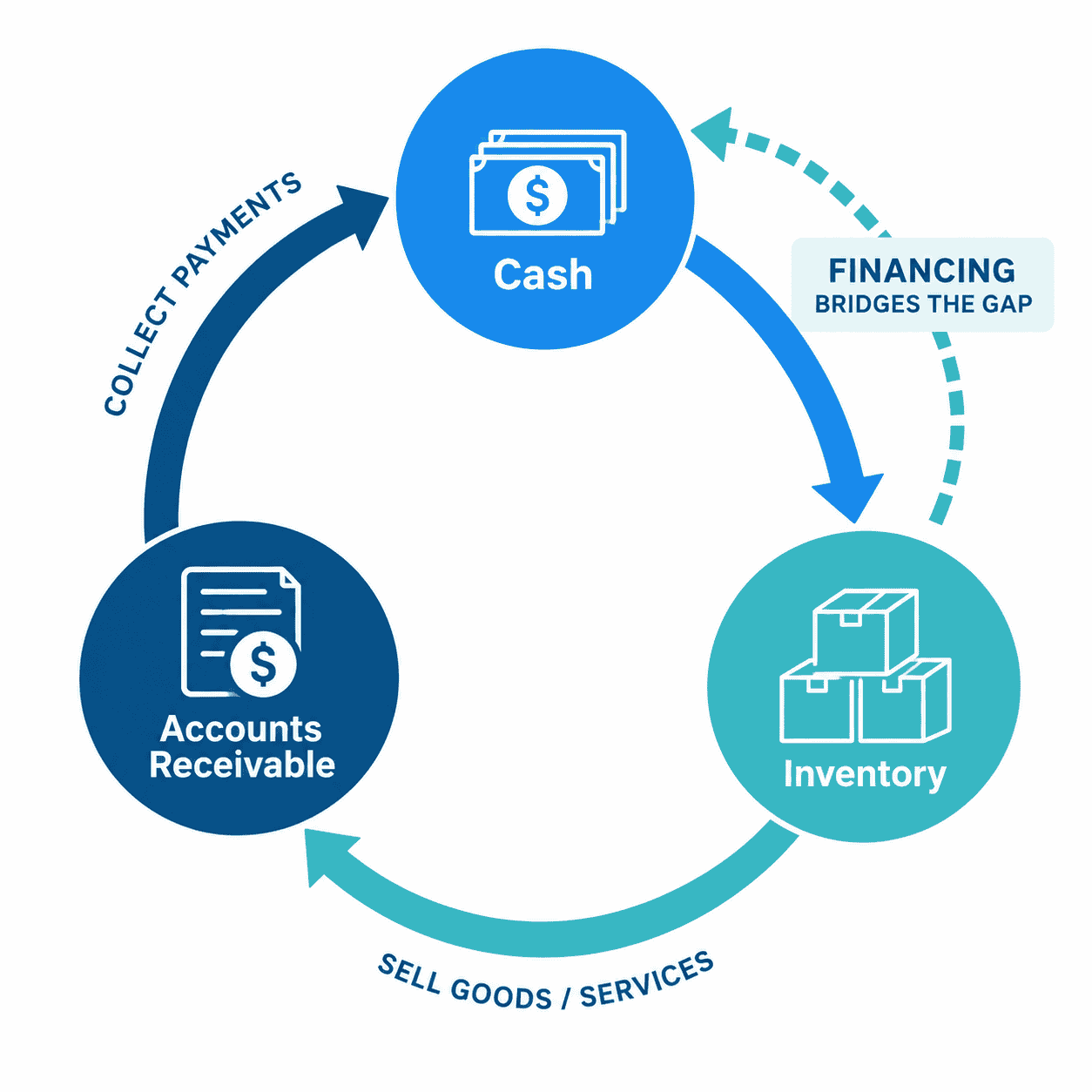
The mechanics are simpler than most borrowers expect. A business identifies its short-term funding gap, applies through a lender or marketplace, receives a lump sum or draws from a credit facility, and repays over a defined period, typically structured around the business’s revenue cycle rather than a fixed calendar. Many modern small business lending products are built for speed, and application timelines have generally shortened compared to traditional bank processes.
The repayment structure varies by product type, but the underlying logic is consistent: the financing is sized to cover a specific operational gap, and repayment begins as cash flows back into the business. Some products tie repayment directly to daily revenue; others use fixed weekly or monthly installments; still others, like SBA loans and traditional term loans, use conventional monthly amortization. The right structure depends on how predictable your cash inflows are, how large the gap is, and what you qualify for.
One important distinction worth flagging early: some working capital products are unsecured, meaning you don’t pledge physical collateral like real estate or equipment. That can make them faster to access, but they’re often priced at higher rates than secured alternatives. Other solutions, including many term loans, SBA loans, and asset-backed lines of credit, are secured, which can mean a lower rate and a longer term, but also a lien against business or personal assets and a longer approval process. Understanding that trade-off upfront is part of making a sound borrowing decision.
Matching the Right Financing to Your Working Capital Gap
Not every financing product fits every business, and the mismatch between product structure and operational cycle is one of the more common mistakes borrowers make. A retail business with predictable daily card sales has different needs than a B2B services firm waiting on 60-day invoices. Matching the financing structure to your actual cash-generation pattern, and to what you actually qualify for, is where the real advantage lies.
A note on sequencing: when more than one option is available, it generally makes sense to start with the most economical, sustainable financing a business qualifies for, and reserve faster or higher-cost products for situations where speed, credit profile, or timing genuinely require it. Below, the options are presented roughly in that order: lower cost and longer term first, faster and higher cost last, though the right starting point always depends on the specific gap, timeline, and qualifications involved.
- SBA Working Capital Loan: Government-backed options through the Small Business Administration, including programs like SBA CAPLines, which provide working capital support to qualifying businesses. These generally offer some of the more favorable rates and terms available to small businesses, but they also involve more documentation and longer application timelines, and not every business will qualify. Best suited to businesses that can plan ahead and don’t need same-week funding.
- Term Loan (Secured or Unsecured): A lump sum repaid on a fixed schedule. When secured by business or personal assets, term loans can offer lower rates and longer repayment periods than unsecured products, in exchange for pledging collateral and a somewhat longer underwriting process. Often used for a specific seasonal purchase, inventory build, or one-time operational need.
- Working Capital Line of Credit: A flexible pool of funds you draw from as needed, paying interest only on what you use. Well-suited for businesses with recurring but variable cash gaps. May be secured or unsecured depending on the lender and the size of the line.
- Accounts Receivable Financing / Factoring: Selling outstanding invoices at a discount to a third party in exchange for immediate cash, which is useful when receivables, not overall creditworthiness, are the primary source of the gap. Cost and structure vary significantly by industry and invoice quality — see our full breakdown of invoice factoring vs. a business line of credit for the details.
- Merchant Cash Advance: An advance against future credit card sales, repaid as a percentage of daily revenue. Among the fastest products to access and often available to businesses with a thinner credit profile, but typically the highest-cost option in this list, and the effective cost can climb further if repayment stretches out. Generally appropriate when speed or qualification constraints rule out the other options above, rather than as a default first choice.
When to Consider Financing a Working Capital Gap
The clearest signal is a persistent mismatch between when obligations come due and when cash arrives. A business paying suppliers in 25 days but collecting receivables in 40 days is running a structural deficit on every operating cycle. That gap doesn’t fix itself. It compounds with every new order.
The scale of this challenge across the U.S. economy is significant. Roughly 350,000 middle-market companies account for over 33% of U.S. GDP, and a substantial portion of them face these exact operational strains. The problem isn’t unique to struggling businesses. It’s widespread across commercial payment cycles.
When clients pay on 30-, 60-, or 90-day terms, the supplier absorbs the financing cost of that delay. You’ve delivered the product or service; your cash is sitting in someone else’s account. Financing can convert that outstanding receivable into usable cash today, so payroll gets met, rent gets paid, and the next order cycle can begin without interruption. The financing isn’t funding new growth; it’s funding the gap between work already done and payment not yet received. That’s a meaningful distinction when evaluating whether the cost of borrowing is justified, and it’s also a clue to which product fits: if receivables are the specific gap, AR financing or a line of credit may be more economical than an MCA.
Seasonal businesses face a different version of the same problem. A landscaping company carrying its winter overhead, or a retailer building holiday inventory in October, needs capital before the revenue arrives. The timing mismatch is predictable and finite, which makes it one of the cleaner use cases for working capital financing, because the repayment source is visible from the start. Predictability like this often makes a business a better fit for a lower-cost term loan or SBA product rather than a faster, pricier option.
During major economic disruptions, businesses often turn to alternative sources or middle-market investment sponsors. That capital exists. The challenge for most small businesses is knowing how to access it efficiently and at a reasonable cost.
Working Capital Financing vs. Term Loan
The distinction comes down to what the money is funding and how long that asset generates returns. Growth-focused term loans and long-term debt are structured to fund major capital expenditures, such as new plants, equipment purchases, and facility buildouts, where the asset produces value over years or decades. The repayment schedule is designed to align with that long productive life.
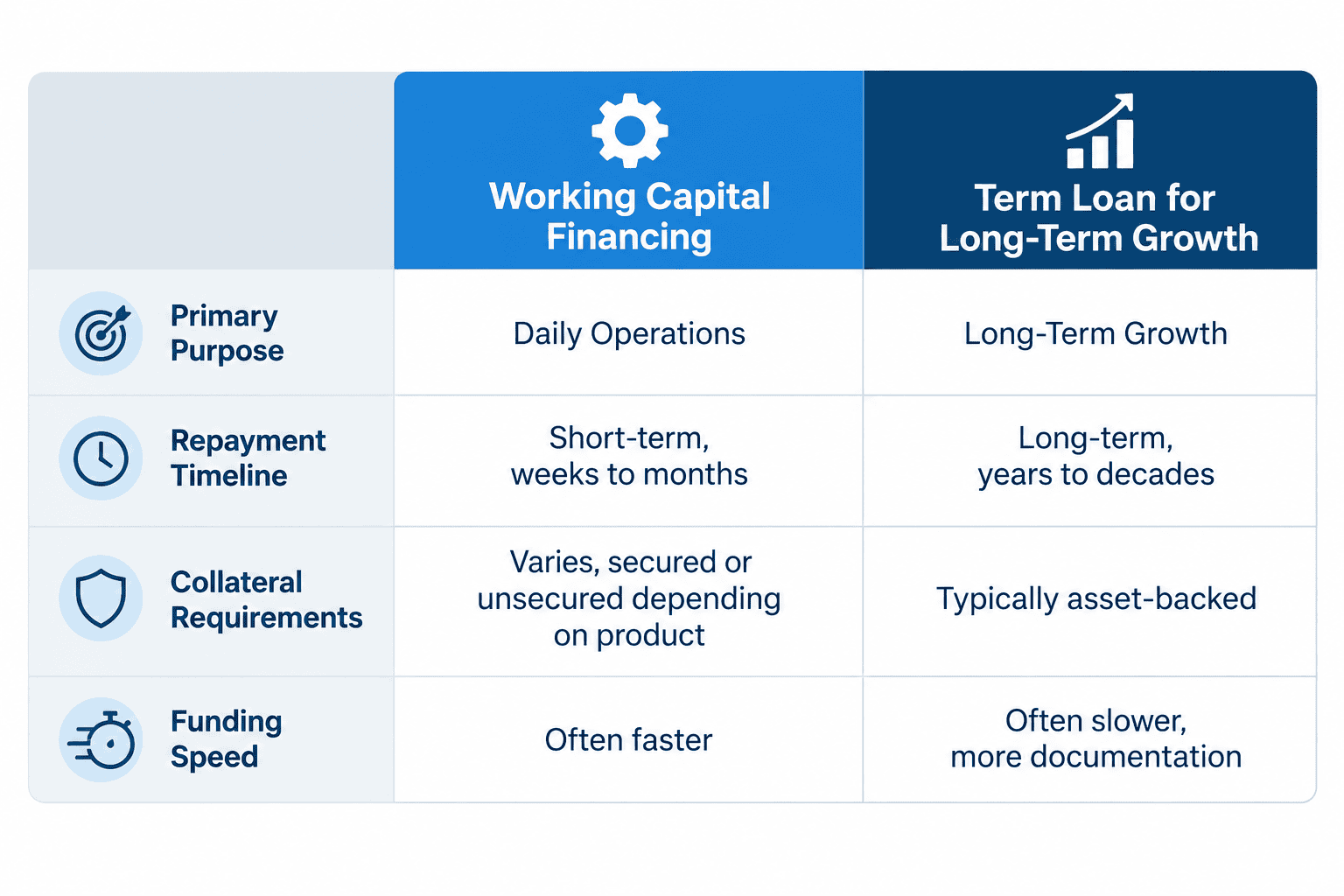
Financing aimed at a working capital gap funds an operational shortfall that closes within weeks or months. The “asset” being financed is a receivable, a seasonal inventory build, or a payroll cycle, all of which convert back to cash relatively quickly. Mismatching these two categories creates real financial risk: relying heavily on short-term debt to fund long-term additions or inflation-driven working capital needs exposes businesses to volatile interest rate swings and heightened refinancing risk.
You wouldn’t buy a house with a 12-month credit card, and you wouldn’t fund next week’s payroll with a 15-year mortgage. The principle is the same: match the duration of the debt to the cash-generation cycle of the asset it’s funding. Short-term financing repaid over weeks to months against a receivable that closes in the same window is sound. Rolling short-term financing repeatedly to fund a permanent structural deficit is a warning sign worth addressing at the operational level first.
You don’t have to navigate these financial decisions alone. Connect with a Dedicated Loan Coach today to discuss your cash flow cycles and find the financing structure that fits your business, whatever form it takes. Checking your rate is a soft pull with no impact on your credit score.
How to Qualify and Apply
Traditional banks have historically made working capital qualification difficult: they often require lengthy documentation, slower underwriting timelines, and have a strong preference for businesses with multi-year track records and substantial collateral. That landscape has shifted considerably. Online lending platforms expanded rapidly during the pandemic-era Paycheck Protection Program, and that experience accelerated a broader shift toward digital underwriting across small business lending.
Fintech platforms and loan marketplaces have compressed the application process for many products, though timelines still vary by lender and loan type. A bank term loan or SBA loan generally takes longer to underwrite than a line of credit or MCA. Underwriting increasingly weights daily cash flow data alongside credit history, which can open doors for businesses that wouldn’t have qualified under traditional bank criteria, though outcomes still depend on the individual lender’s guidelines.
Whether a product is secured or unsecured matters here too. Unsecured working capital products are frequently faster to access but tend to lean more heavily on revenue consistency and time-in-business as qualifying factors, and often carry a higher rate than a comparable secured product. Secured options may offer better pricing in exchange for collateral and a longer process. Understanding what a specific lender is evaluating, and what’s actually being pledged, reduces friction and surprises later in the process.
Calculating Your Working Capital Requirements
The working capital formula is one of the more useful numbers a business owner can track regularly, and it requires nothing more than two line items from your balance sheet. Current assets minus current liabilities gives you your net working capital: a positive number means you have a buffer, while a negative number means your short-term obligations exceed your liquid assets, which is a clear quantitative signal that financing may be worth exploring.
Walking through a net working capital calculation concretely: if your business holds $80,000 in cash, receivables, and inventory (current assets) and carries $55,000 in unpaid supplier invoices and short-term debt due within 12 months (current liabilities), your net working capital is $25,000. That buffer tells you how much runway you have before a cash gap becomes a cash crisis. Tracking this number monthly, rather than just at year-end, gives you enough lead time to act before the gap becomes urgent.
Current assets in this calculation include cash on hand, accounts receivable, short-term investments, and inventory. Current liabilities include accounts payable, accrued expenses, and any debt due within the next 12 months. Long-term assets like real estate or heavy equipment don’t belong in this calculation; they’re not liquid enough to cover near-term operating obligations.
The operating expense ratio adds another layer of diagnostic clarity: divide your total operating expenses by your net revenue to see what percentage of every dollar earned goes back out the door to keep the business running. A rising ratio over consecutive periods is an early warning sign worth investigating before it shows up in your bank balance. One accounting question that often surfaces here is whether depreciation counts as an operating expense. Technically, yes, it appears on the income statement as an operating cost, but since it’s a non-cash charge, it gets added back when calculating actual cash flow. That distinction matters when you’re projecting how much cash your business really generates versus what the income statement suggests.
Pros and Cons of Working Capital Financing
The case for working capital financing, broadly, is rapid access to funds relative to long-term capital financing, no equity dilution, and flexible deployment across any operational expense. You retain full ownership and control of your business, and the capital can cover whatever the operation needs: payroll, inventory, a supplier deposit, or a bridge through a slow month. For a business with a clear, finite cash gap, a visible repayment source, and a product matched to that gap, it’s a clean instrument.
The limitations deserve equal attention. Shorter repayment windows on faster products mean higher periodic payments, which can strain cash flow if the revenue cycle takes longer than expected to close. Unsecured products often carry higher interest rates than secured alternatives, reflecting the lender’s increased risk, while secured products carry the risk of a lien on pledged assets if the loan isn’t repaid. Some lenders impose restrictive rules, such as limitations on asset sales, financial reporting requirements, or controls on how cash is used, that can constrain operational flexibility in ways borrowers don’t always anticipate until they’re mid-loan.
The cost structure warrants a clear-eyed look before signing. Traditional bank covenants can restrict asset sales or require personal guarantees from business owners. Commercial loan brokers, when engaged to find terms, often charge a commission on the loan amount at closing, a cost that ultimately passes to the borrower. Working with a transparent partner who outlines all costs upfront, including origination fees, draw fees, and any prepayment terms, is worth prioritizing over chasing the lowest advertised rate alone.
Frequently Asked Questions
What is working capital, with an example?
Working capital is the available money your business has for its day-to-day operations. It’s a measure, not a loan. If a local retail store has $50,000 in cash and inventory (current assets) and owes $20,000 in unpaid supplier invoices (current liabilities), its working capital is $30,000, which is the amount available to keep operations running before new revenue arrives.
What qualifies as working capital?
Working capital consists of current assets convertible into cash within a single year: cash on hand, accounts receivable, short-term investments, and current inventory, minus current liabilities. It leaves out long-term assets like real estate, heavy machinery, or equipment, as those can’t be liquidated quickly enough to cover near-term operating obligations.
How do I calculate working capital?
Use the formula: Current Assets minus Current Liabilities. Add up everything your business owns that can be converted to cash within 12 months, then subtract all debts and obligations due in the same window. The result is your net working capital: positive means a buffer exists, while negative means the gap needs addressing.
What financing options can address a working capital gap?
Depending on the size and duration of the gap and what a business qualifies for, options range from SBA loans and term loans (typically the most economical for businesses that can plan ahead) to lines of credit and accounts receivable financing, up to merchant cash advances for businesses that need speed or have a thinner credit profile. There isn’t one “working capital loan” product; it’s a category of solutions matched to the gap.
What credit score is needed for working capital financing?
This varies by product and lender, and generally trends lower for shorter-term or revenue-based products and higher for bank and SBA products.
Talk to a Smarter Credit Representative Today
Managing cash flow doesn’t have to be a source of constant stress, and it certainly doesn’t require figuring everything out before you talk to anyone. The businesses that handle these gaps most effectively are the ones that treat financing as a planning tool: something you explore before the gap becomes a crisis, not after. Checking your options is a soft credit pull, takes a few minutes, and gives you real numbers to work with rather than estimates. You don’t have to figure this out alone; we are here to help you find a clear path forward.
Ready to see what options are available for your business? Connect with a Dedicated Loan Coach today to simplify your cash flow. Checking your rate is a soft pull with no impact on your credit score. Let’s find a solution together.