

Invoice Factoring vs. Business Line of Credit: What Every Small Business Owner Needs to Know

You delivered the work. You sent the invoice. And now you wait, often 30, 60, or even 90 days, while payroll, rent, and supplier payments keep arriving on schedule. That gap between earning revenue and actually holding it is one of the most taxing parts of running a B2B business. It’s also the gap that sends a lot of owners searching for invoice factoring.
Factoring is worth understanding, but for most small businesses it isn’t the right tool, and it isn’t something Smarter Credit leads with. As your dedicated Loan Coach, our job is to walk you through how factoring actually works, where it can make sense as a narrow, special-case solution, and why a business line of credit is the more sustainable, relationship-safe way to close that same cash-flow gap for the vast majority of the businesses we work with. From there, we’ll get into the fuller lineup of financing tools — term loans, SBA financing, merchant cash advances, and real estate-secured financing — that we actually build most of our clients’ cash-flow strategies around.
What Invoice Factoring Is
Invoice factoring isn’t a loan. It’s an asset sale: you sell your unpaid invoices to a third-party company at a discount, trading a slice of your earned revenue for cash today. That distinction shapes everything about how it works, what it costs, and what it does to your customer relationships.
Three parties show up in every factoring transaction:
- The Seller (Your Small Business): You’ve delivered goods or services, generated an invoice, and you’re waiting on payment from a corporate client.
- The Debtor (Your Customer): Your B2B client who owes the invoice balance. Their creditworthiness, not yours, is really what the factoring company cares about.
- The Factor (The Factoring Company): The financial entity that buys your invoice at a discount, advances most of the cash to you, and then collects the full invoice amount directly from your customer.
How It Works, Step by Step
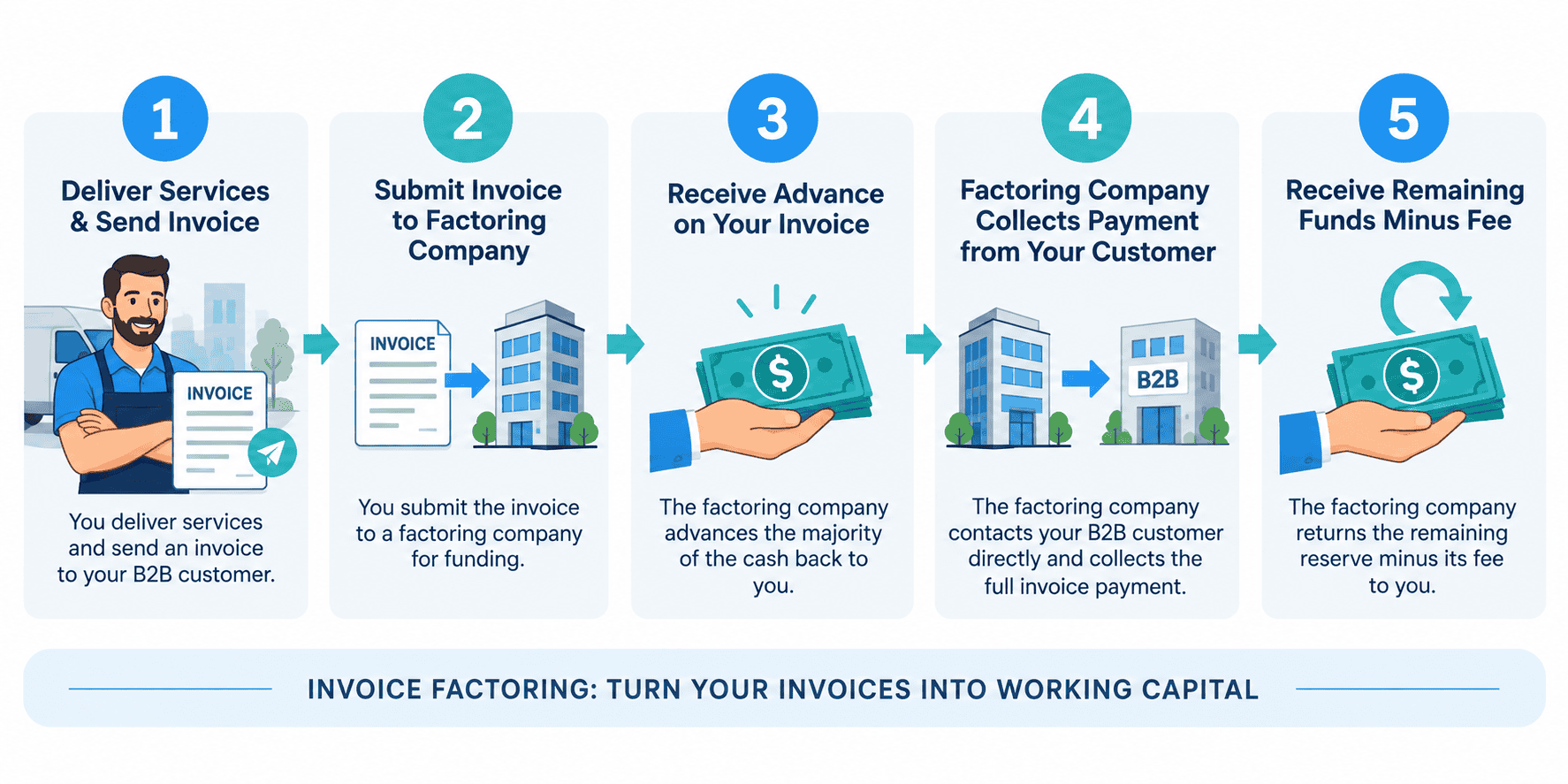
Think of it like selling a gift card at a discount. You’re holding a card worth $10,000, but instead of waiting for someone to redeem it at full value, you sell it today for $9,000. You get the cash now, and the buyer collects the full amount later. Invoice factoring applies that same idea to your accounts receivable.
You invoice your customer as usual, then submit a copy of that invoice to the factoring company. The factor reviews it along with your customer’s credit profile, then advances the majority of the invoice value directly to your account, typically within a couple of business days. A reserve portion gets held back until final collection.
Once your customer pays the factor in full, the factor deducts its fee from that reserve and sends you the rest. Invoice aging is the variable that matters most here: every extra week your customer takes to pay bumps up the fee, and that eats directly into your profit on the job.
Why Factoring Is a Narrow, Special-Case Fit
Factoring companies aren’t built for every business, and most set volume thresholds that rule out smaller operators before cost even enters the picture. It’s common for factoring providers to want somewhere around $300,000 or more in monthly invoice volume before they’ll take on a client, along with extra underwriting steps: deeper due diligence on your corporate customers, ongoing verification of delivery or completion, and periodic re-review of the receivables you’re factoring. That combination of a high-volume floor and heavier verification is part of why we treat factoring as a referral-only option. It’s a real solution for a specific kind of business, usually one with large, concentrated B2B receivables and a corporate client base with strong payment histories, but it’s not a general-purpose cash-flow tool. If that’s your situation, we’re happy to talk it through or point you to a factoring partner. For most of the businesses we work with, though, a line of credit or one of our other core products gets you the same working capital without the trade-offs below.
The Hidden Costs and Fees of Factoring
The fee structure is where a lot of business owners get an unwelcome surprise, not because the fees are buried in fine print, but because the compounding effect over 30 to 90 days is easy to underestimate going in.
- The Factor Fee (Discount Fee): The main charge, calculated as a percentage of the invoice value. It’s not a flat, one-time fee. It typically scales up in increments the longer the invoice sits unpaid. A slow-paying client doesn’t just cost you time; they cost you a growing share of your revenue on that transaction.
- Administrative and Service Fees: Application fees, lockbox fees, credit check fees on your customers, and monthly minimum volume requirements can all stack on top of the discount fee. These add up regardless of how quickly your customers pay.
- The Effective Annual Percentage Rate (APR): Because factoring fees are assessed over weeks instead of a full year, the annualized cost of capital can end up much higher than it looks when you’re just eyeing a single invoice fee. Owners who skip that calculation before signing often end up in an arrangement that costs a lot more than a revolving line of credit would.
Recourse vs. Non-Recourse Factoring
- Recourse Factoring: The more common, generally cheaper structure. Your business keeps the ultimate liability. If your customer doesn’t pay within the agreed window, you have to buy back the invoice or swap in a new one of equal value.
- Non-Recourse Factoring: The factor absorbs the credit risk if your customer becomes unable to pay, but that protection is usually narrow, often limited to something like bankruptcy rather than a general failure to pay. If a customer withholds payment because they’re disputing the quality of your goods or services, that’s a performance dispute, not a credit event, and the liability lands back on you no matter how the agreement is structured.
The Customer Relationship Risk: Notice of Assignment
This is the part of factoring that marketing materials tend to skip over.
When you sell an invoice to a factoring company, the factor sends a Notice of Assignment (NOA) directly to your customer. It’s a legal document telling them to redirect future payments to the factor’s lockbox instead of your business. Your customer finds out, often without any heads-up from you, that a third party now has the right to collect their payment.
For a lot of B2B relationships, that creates friction. Clients who’ve worked with you for years might read the NOA as a sign that your business is struggling, even if things are perfectly healthy. Factoring companies also routinely run manual verification before advancing cash, which can mean a representative calling or emailing your customer to confirm delivery or completion of work. From your customer’s accounts payable team’s perspective, that’s an unfamiliar financial institution asking questions about a vendor they already trust, and it’s friction they didn’t sign up for.
The Legal Hurdle: UCC-1 Liens
Factoring also comes with a legal consequence that can limit your financial flexibility well after the arrangement ends. Factoring companies typically file a UCC-1 blanket lien against your business assets as standard practice, which puts on public record that the factor holds a legal claim over your receivables. Any future lender — a bank, an SBA lender, or an equipment finance company — will see that lien and generally won’t want to sit in a secondary position behind the factor. A factoring deal meant to solve a short-term cash-flow problem can end up quietly closing off longer-term financing options as your business grows.
Why a Business Line of Credit Is the Better Fit for Most Businesses
A revolving business line of credit closes the same gap between earning revenue and actually receiving it, without putting a third party in the middle of your customer relationships and without a public lien on your assets. For B2B businesses where client trust is a real competitive advantage, that difference isn’t a minor detail. It’s the whole point.
- Complete Privacy: Your customers never know you’re using a line of credit. You invoice as usual, they pay you directly, and your financing stays your own business. No NOA, no lockbox redirect, no third-party calls.
- Pay Only for What You Use: Unlike factoring, where you sell entire invoices and absorb fees on the full amount, a line of credit lets you draw exactly what you need and pay interest only on that balance.
- Revolving Flexibility: As you repay, your available credit comes back automatically, sitting there as a standing resource for predictable seasonal gaps or an unexpected slow-paying client.
- No Manual Customer Verification: No calls or emails to your clients confirming delivery, and no disruption to their accounts payable workflow.
Comparing the Two
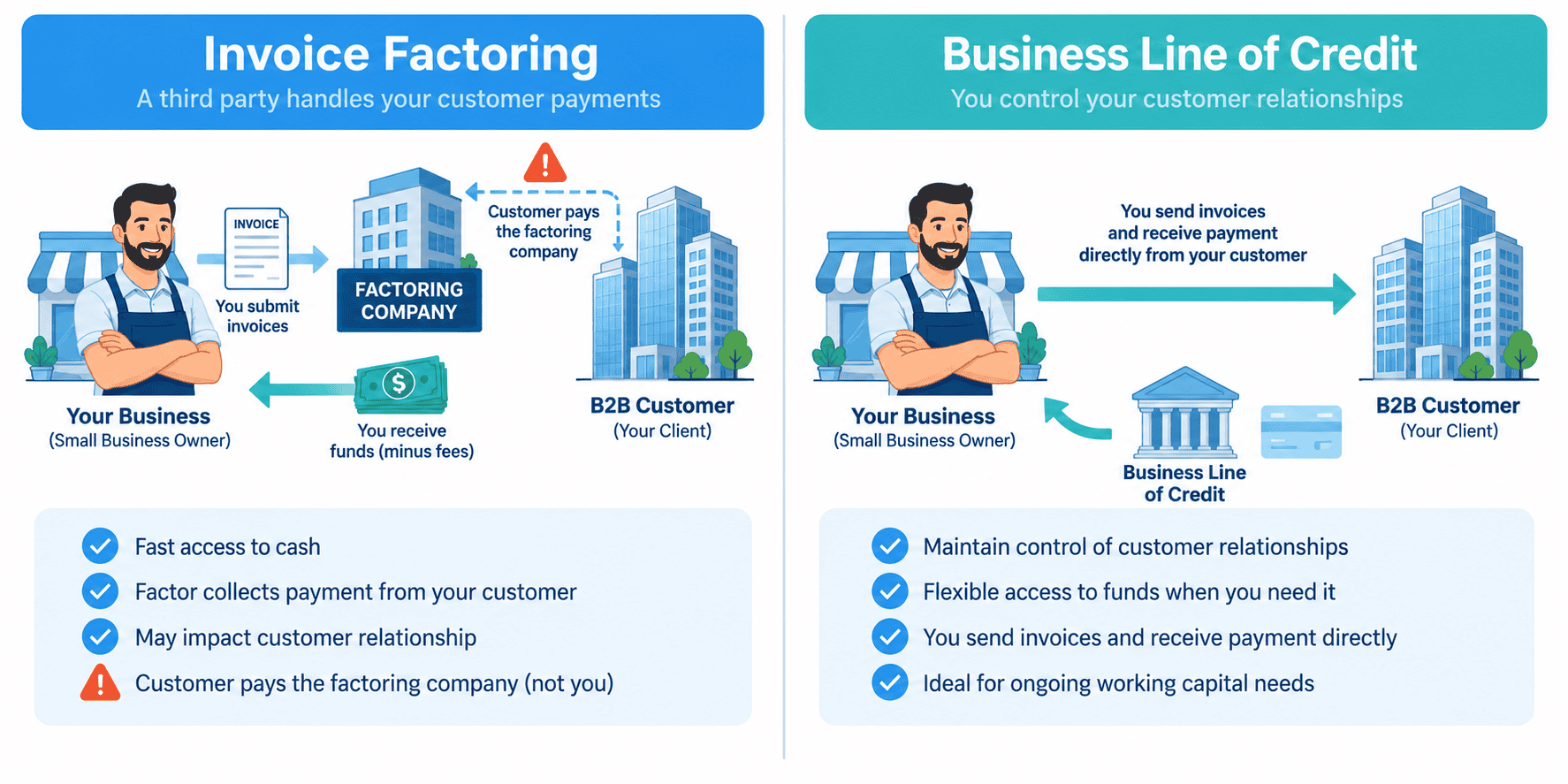
Invoice factoring is a tactical fix for a specific situation. It solves an immediate cash-flow problem by selling off a portion of earned revenue, and it does that by pulling a third party into a customer relationship you built over years. The cost isn’t just the factor fee. It’s the compounding weekly fees, the UCC-1 lien that narrows your future financing, and relationship friction that’s hard to put a number on but very real. It also typically requires a scale of receivables, often $300K+ in monthly invoice volume, that rules it out for a lot of small businesses from the start.
A business line of credit is a structural tool. It’s built to simplify your cash-flow management over time, giving you a revolving resource that grows with your business instead of a one-off transaction you have to repeat every time a client pays slowly. If your gap is broader than receivables timing, it may also help to see how a line of credit fits alongside other tools for closing a working capital gap.
Beyond the Line of Credit: The Rest of the Toolkit
A line of credit solves the recurring, short-term gap between invoicing and payment. But cash-flow needs don’t all look the same, and Smarter Credit builds most client strategies around a broader set of core products:
- Business Term Loans: For a defined amount of capital repaid on a fixed schedule — think equipment, expansion, or a lump-sum need where you want predictable payments instead of a revolving balance. This is usually where we start the conversation for owners planning a specific investment in their business.
- Business Lines of Credit: The revolving, on-demand tool described above. Draw what you need, pay interest only on that balance, and let your available credit restore as you repay.
- SBA Financing: Government-backed loans that often come with longer terms and lower rates than conventional financing. We can typically move fast on a preliminary or pre-approval decision, and qualifying deals can sometimes see funding in as little as roughly three weeks — faster than the SBA process usually gets credit for.
- Merchant Cash Advances: A faster, more flexible bridge option for businesses that need working capital quickly and can repay through a share of ongoing sales. Useful when timing matters more than getting the lowest possible cost of capital.
- Real Estate-Secured Business Financing: Financing secured by commercial or investment real estate you own. Useful when you want to unlock capital tied up in property to fund growth, cover a gap, or refinance existing debt on better terms.
Frequently Asked Questions
Is factoring invoices a good idea?
For a narrow set of businesses, typically those with large, concentrated B2B receivables, strong-paying corporate clients, and enough monthly invoice volume (often $300K or more) to meet a factor’s minimums, it can provide a fast cash-flow bridge. For most small businesses, though, the cumulative fees, the Notice of Assignment sent to customers, and the UCC-1 lien make it a harder arrangement to sustain than a business line of credit or one of Smarter Credit’s core lending products.
How much does invoice factoring typically cost?
Costs center on a discount fee that climbs the longer your customer takes to pay, often layered with administrative, lockbox, and credit check fees. Because these accumulate over 30- to 90-day cycles rather than annually, the effective cost of capital can end up meaningfully higher than a single-invoice fee would suggest.
Can small businesses get invoice financing?
Approval is based mainly on your customers’ creditworthiness rather than your own, and most factors also want a meaningful volume of monthly invoices, often $300K+, along with additional due diligence. That combination means factoring tends to fit a specific kind of business more than it works as a general-purpose option for smaller companies.
What are the disadvantages of invoice factoring?
High cumulative fees, less direct control over your receivables, the Notice of Assignment sent to customers, manual verification calls that can create friction with clients, and, under recourse agreements, the obligation to buy back invoices your customers don’t pay.
Is invoice factoring legal?
Yes. It’s a legal sale of accounts receivable governed by the Uniform Commercial Code, not a loan, which is why the factor gets the right to collect directly from your customer. Its legality isn’t in question. Its cost and how it fits your business are what deserve a closer look before you sign.
Check Your Rates With Smarter Credit Today
Managing cash flow shouldn’t mean putting the customer relationships you’ve spent years building at risk. At Smarter Credit, we start most conversations with term loans, lines of credit, SBA financing, merchant cash advances, or real estate-secured financing, and we’ll only point you toward factoring if it’s genuinely the better fit for your situation.
Ready for a smarter cash-flow solution? Try a risk-free rate check at no cost, with no impact on your credit score, and let’s build a financing strategy around the products that actually fit your business.